

Every safari destination in Africa offers wildlife. The Ngorongoro Conservation Area offers something rarer — a complete ecological world, enclosed by ancient volcanic walls, where the full drama of predator and prey, of birth and death and the slow turning of the seasons, plays out in a landscape of such concentrated beauty that it stops you mid-sentence and holds you there.
Introduction
The word “safari” derives from the Swahili and Arabic for “journey.” And while every great African wildlife experience is a journey in the literal sense — through landscapes of increasing remoteness and wonder — the Ngorongoro wildlife safari offers a journey of a different, deeper kind. It is a journey into geological time, into evolutionary history, and into an encounter with one of the most intact and extraordinary ecological systems remaining anywhere in the natural world.
The Ngorongoro Conservation Area encompasses far more than the famous crater for which it is best known. Covering approximately 8,292 square kilometres of northern Tanzania, the Conservation Area incorporates the Ngorongoro Crater itself, the surrounding Ngorongoro Highlands, the Olmoti and Empakaai craters, the Eyasi escarpment, the famous Olduvai Gorge — one of paleoanthropology’s most significant sites — and a series of game-rich plains and forest zones that together constitute one of the most ecologically diverse protected areas in East Africa.
A Ngorongoro wildlife safari that engages with this full range of ecosystems — rather than limiting itself to the crater floor alone — delivers a breadth and depth of wildlife experience that rivals any comparable journey in Tanzania. From the dense predator community of the crater floor to the elephant herds of the highland forests, the flamingo-lined shores of the Empakaai Crater lake, and the extraordinary human heritage of the Leakey family’s Olduvai excavations, the Ngorongoro Conservation Area is a destination of layered richness that rewards multiple days of dedicated exploration.
This guide covers the full wildlife safari potential of the Ngorongoro Conservation Area — its ecosystems, its species, its seasonal rhythms, and the planning framework that delivers the most complete and rewarding experience of this extraordinary African landscape.
The Ngorongoro Crater: Wildlife Safari at Its Most Concentrated
An Ecosystem Without Equal
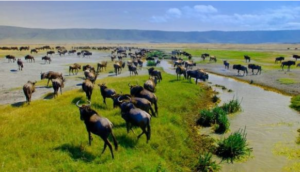
The Ngorongoro Crater floor — 19 kilometres across, 260 square kilometres in total area, enclosed by volcanic walls rising nearly 600 metres above the caldera — is the most wildlife-dense enclosed ecosystem in Africa. Its permanent water sources, year-round grazing, and self-contained geography maintain a resident animal community of approximately 25,000 to 30,000 large mammals that are present throughout the year, creating wildlife safari conditions of extraordinary reliability and intensity in every season.
No other single location in Tanzania — or arguably in Africa — concentrates the Big Five so reliably within such a contained and navigable space. The crater’s lions, elephants, buffalos, leopards, and critically protected black rhinoceros share a landscape compact enough to be meaningfully covered in a single full day yet complex enough to reward multiple days of dedicated safari exploration.
Lions of the Crater
The Ngorongoro Crater supports approximately 70 lions in around eight distinct prides — a density that makes lion encounters one of the most reliable wildlife safari experiences available in East Africa. These prides have been continuously studied by researchers for decades, and many individual animals are known and identifiable by name and by the specific characteristics of their facial markings and pride histories.
What makes Ngorongoro’s lions particularly compelling as a safari subject is the quality of their habituation and the openness of the terrain in which they are observed. The crater’s short-grass plains offer unobstructed sightlines across hundreds of metres, and the animals’ complete comfort in the presence of safari vehicles allows for the kind of extended, close-range observation of pride dynamics — the hierarchy of females, the tenure of male coalitions, the developmental stages of cubs across months and years — that is simply unavailable at less intensively studied and less accessible lion populations.
The Black Rhinoceros — Africa’s Most Precious Wildlife Safari Encounter
Of all the wildlife safari encounters available in the Ngorongoro Conservation Area, none carries the weight and significance of the black rhinoceros. Tanzania’s rhino population was reduced to near-extirpation by the poaching crisis of the 1970s and 1980s, and the Ngorongoro Crater’s current population of approximately 20 to 30 individuals — protected by dedicated ranger units operating 24 hours a day, 365 days a year — represents both the most accessible black rhino population in Tanzania and one of the most intensively protected groups of animals in Africa.
Encountering a black rhinoceros on the crater floor is an experience that experienced safari travellers consistently describe as the most emotionally resonant of their entire Tanzania journey. The prehistoric bulk and ancient presence of this extraordinary animal — browsing on the short grass in apparent indifference to a world that has tried to kill it to extinction and nearly succeeded — is a wildlife safari encounter of profound moral and emotional weight, as well as extraordinary visual magnificence.
The Predator Guild Beyond Lions
The crater’s spotted hyena population is among the densest in Africa, with hyena clans occupying territories across the full extent of the crater floor. Far more ecologically significant than their scavenger reputation suggests, spotted hyenas are accomplished cooperative hunters whose social complexity rivals that of elephants and primates. The Ngorongoro Crater is one of the finest locations in Africa for observing the full behavioural range of spotted hyena society — clan gatherings at den sites, complex dominance interactions, competitive feeding at kills, and the remarkably devoted parental behaviour that hyena matriarchs direct toward their cubs.
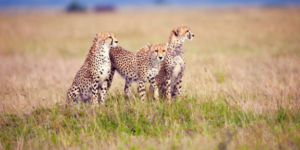
Leopards inhabit the crater rim forest and occasionally descend to the floor, where sightings are uncommon but remarkable when they occur. The open terrain of the crater floor exposes a descending leopard to the full attention of the crater’s hyena and lion populations, creating a predator dynamic of considerable tension. Cheetahs are present in small numbers on the open plains, and the crater’s compact geography means that a cheetah hunt — when it occurs — unfolds across a landscape that can be followed by a well-positioned vehicle with exceptional visibility.
Elephants of the Lerai Forest
The Ngorongoro Crater’s elephant population is dominated by large bull elephants — often carrying tusks of impressive length and weight — who favour the Lerai Forest’s freshwater springs and the mineral-rich volcanic soils of the crater floor. Encounters with these ancient, independent males in the dappled light of the fever tree forest edge are among the most visually spectacular wildlife safari experiences in the Conservation Area, and the bulls’ apparent calm and familiarity with vehicles creates opportunities for extended observation at genuinely close range.
Beyond the Crater: The Conservation Area’s Wildlife Safari Landscape
The Ngorongoro Highlands
The elevated forest and grassland zones of the Ngorongoro Highlands — rising to over 3,600 metres at the highest points of the Conservation Area — support a wildlife community quite different from the crater floor, and one that is largely overlooked by safari travellers who limit their experience to the caldera.
Elephant herds with full family group social structures — matriarchs, adult females, juveniles, and calves — move through the highland forests in patterns shaped by generations of ecological memory. Cape buffalo in large herds graze the highland grasslands. Eland — Africa’s largest antelope — are more commonly encountered in the highlands than on the crater floor. Bushbuck, waterbuck, and several inhabit the forest margins, and the highland forests support colobus monkey populations whose black-and-white plumage and resonant calls make them one of the most visually and acoustically striking primates in East Africa.
The Ngorongoro Highlands’ birdlife is exceptional, with the montane forest zone supporting species unavailable on the crater floor: Hartlaub’s turaco, bar-tailed trogon, African crowned eagle, and a rich diversity of sunbirds, warblers, and forest raptors that reward dedicated birding attention.
Empakaai Crater — The Hidden Wildlife Safari Gem
Empakaai Crater is, for many wildlife safari travellers who discover it, the most unexpected and most rewarding wildlife experience in the entire Ngorongoro Conservation Area. A smaller and less famous caldera than the Ngorongoro itself, Empakaai’s 3.5-kilometre-wide crater is filled by a deep, alkaline lake of extraordinary beauty — surrounded by dense montane forest, with walls rising steeply from the water’s edge and a crater rim that offers one of the finest landscape views in northern Tanzania, encompassing the Ngorongoro Crater, the Serengeti plains, and on clear days, the distant bulk of Kilimanjaro and Ol Doinyo Lengai.
Empakaai is accessible by guided walking safari from the crater rim — a two to three hour descent through montane forest and along the lake shore that delivers wildlife encounters of remarkable intimacy. The lake supports large flamingo gatherings and a diverse waterbird community. Buffalo graze the crater floor grasslands. Bushbuck and Harvey’s duiker move through the forest margins. Waterbuck and reedbuck inhabit the lake shore grasslands. The forest itself is alive with primates, birds, and the small mammals of the highland zone.
The Empakaai walking safari is not simply a wildlife activity — it is a physical and sensory experience of genuine depth, moving through an enclosed volcanic landscape of profound beauty with the guidance of an experienced ranger who interprets the ecology, geology, and cultural significance of the landscape at every level.
Olmoti Crater — Wildlife Safari and Highland Wilderness
Olmoti Crater, north of Empakaai and similarly accessible by guided walking safari, offers a different highland wildlife experience. The crater’s shallow floor is traversed by the Munge River — one of the primary water sources for the Ngorongoro Crater’s permanent springs — and the grassland and forest margins support significant buffalo herds, elephant, waterbuck, reedbuck, and a diverse bird community including the spectacular grey crowned crane.
An Olmoti walking safari typically takes two to three hours and is combined with an overnight stay at a wilderness camp on the crater rim, creating a highland safari experience of exceptional remoteness and ecological richness.
Olduvai Gorge — The Wildlife Safari’s Human Dimension
No Ngorongoro wildlife safari is fully complete without engagement with the Olduvai Gorge — the dramatic ravine that cuts through the Serengeti plains west of the Ngorongoro Highlands and contains one of the most significant paleoanthropological records in the world. The Leakey family’s excavations here from the 1930s onward revealed fossil evidence of early human ancestors — including Homo habilis and Australopithecus boisei — alongside the tools, bones, and ecological traces of the environments in which our species’ predecessors lived, hunted, and evolved.
Visiting Olduvai as part of a Ngorongoro wildlife safari — pausing between a crater floor game drive and the drive to the Serengeti, or as a dedicated morning excursion from a Ngorongoro rim base — adds a dimension of human meaning to the wildlife experience that transforms the journey from a wildlife tour into something closer to a meditation on the deep history of life, landscape, and the long, improbable story of the species doing the observing.
Seasonal Guide to the Ngorongoro Wildlife Safari
Dry Season (June to October)
The dry season delivers the clearest skies, the best crater floor road conditions, and the most concentrated wildlife around the crater’s permanent water sources. Predator activity is high and visible, the short grass of the drying plains exposes wildlife that would otherwise be concealed in longer vegetation, and the cool, crisp air of the Ngorongoro mornings creates atmospheric conditions of extraordinary quality. This is peak safari season across the Conservation Area, and accommodation should be booked well in advance.
Wet Season (November to May)
The wet season transforms the Ngorongoro Conservation Area into a landscape of remarkable beauty — the crater floor and highlands turn vivid green, newborn animals appear across all species, and the seasonal flamingo gatherings at Lake Magadi reach their most spectacular concentrations. The long rains of April and May bring some track access challenges on the crater floor and in the highlands but also the fewest visitors, the most competitive accommodation rates, and a landscape of extraordinary photogenic quality that rewards photographers who are willing to work with dramatic cloud light and lush green backgrounds.
Planning Your Ngorongoro Wildlife Safari
Duration
A meaningful Ngorongoro wildlife safari requires a minimum of two to three nights at a rim or Karatu base to accommodate two full crater floor days and at least one highland or secondary crater excursion. Three nights allows for two crater days, an Empakaai or Olmoti walking safari, and an Olduvai visit — the combination that delivers the Conservation Area’s full ecological and human heritage depth. Four nights or more permits a more leisurely exploration pace and the opportunity to repeat productive crater circuits on different days.
Accommodation
Crater rim lodges and tented camps offer spectacular caldera views, immediate access to the descent gate, and the atmospheric quality of the highlands altitude. The rim ranges from mid-range lodges with comfortable en-suite rooms to several of Tanzania’s most celebrated luxury properties. Karatu provides excellent budget and mid-range accommodation at lower price points with practical gate access for early morning descents.
Key Takeaways
- The Ngorongoro Conservation Area encompasses 8,292 square kilometres of diverse ecosystems — crater floor, highlands, secondary craters, and gorge — delivering a wildlife safari of far greater ecological breadth than a crater-only visit can provide.
- The black rhinoceros is Tanzania’s most significant and most emotionally powerful wildlife safari encounter — the crater’s intensively protected population of 20 to 30 individuals is the most reliably accessible in the country.
- Empakaai Crater’s guided walking safari is one of the most underrated and most rewarding wildlife experiences in the entire Ngorongoro Conservation Area — a two to three hour descent into a forest-enclosed volcanic lake of extraordinary beauty.
- Year-round wildlife reliability distinguishes the Ngorongoro Crater from the Serengeti — the enclosed ecosystem’s permanent water and resident animal community maintain consistent wildlife density in every season.
- The Ngorongoro Highlands’ elephant herds and forest wildlife represent a completely different and highly rewarding wildlife safari dimension beyond the crater floor’s plains game community.
- Olduvai Gorge adds a uniquely powerful human heritage dimension to the Ngorongoro wildlife safari — situating the contemporary wildlife encounter within the three-million-year evolutionary story of the landscape and its inhabitants.
- A minimum of three nights is required to access the full wildlife safari potential of the Ngorongoro Conservation Area — two crater days and at least one secondary excursion to highlands, Empakaai, or Olduvai.
Questions & Answers
Q: What makes the Ngorongoro wildlife safari different from a Serengeti safari? A: The two experiences are fundamentally complementary rather than comparable. The Serengeti delivers vast scale, open-horizon freedom, the Great Migration, and the sense of genuinely boundless wilderness. The Ngorongoro delivers concentrated intensity — the highest wildlife density in Africa within a contained and legible landscape, the black rhinoceros encounter unavailable elsewhere in Tanzania, the extraordinary geological drama of the caldera setting, and an ecological completeness (all Big Five reliably present year-round) that the Serengeti’s scale and seasonal dynamism cannot match within a single confined location. The Ngorongoro wildlife safari also offers a broader ecological range — highlands, secondary craters, gorge — that extends beyond what a Serengeti safari provides. Most safari professionals recommend experiencing both destinations within the same itinerary, allocating at least two nights to each.
Q: How reliable is the Ngorongoro wildlife safari for Big Five encounters? A: The Ngorongoro Conservation Area offers the highest Big Five reliability of any single Tanzania safari destination. Lion: near-certainty across any two-day crater visit. Elephant: high probability in the Lerai Forest and crater floor plains. Buffalo: near-certainty — enormous herds on the crater floor year-round. Leopard: lower probability on the crater floor, higher in the highland forest zones. Black rhinoceros: good probability over two dedicated crater days with expert guide intelligence, lower on a single day visit. The crater’s reliable year-round wildlife density means that this Big Five reliability is consistent across seasons — a significant advantage over destinations whose wildlife distribution shifts dramatically with rainfall and migration patterns.
Q: Is the Ngorongoro Conservation Area suitable for walking safaris? A: Yes — and the walking safari opportunities within the Conservation Area are among the finest in northern Tanzania. Empakaai Crater offers an exceptional two to three hour guided walking descent to the crater lake through montane forest. Olmoti Crater provides a highland grassland and forest walking experience with good wildlife and spectacular views. Ngorongoro Highlands trails connect the major crater viewpoints through moorland and forest habitats of considerable ecological interest. All walking safaris in the Conservation Area are conducted with licensed, armed ranger escorts and require advance booking through the NCAA or a registered safari operator. Walking safaris on the Ngorongoro Crater floor itself are not permitted under Conservation Area regulations.
Q: What are the accommodation options for a Ngorongoro wildlife safari? A: Accommodation options span the full range from budget to ultra-luxury. Crater rim lodges — positioned on the outer rim with direct crater views and immediate gate access — range from comfortable mid-range properties at approximately $150 to $300 per person per night to several of Tanzania’s most celebrated luxury tented camps and lodges at $600 to $2,000+ per person per night, fully inclusive. Karatu town accommodation (20 kilometres outside the Conservation Area gate) provides excellent budget and mid-range options at $80 to $250 per person per night, with easy 45-minute road access to the descent gate for early morning starts. Ngorongoro Farm House and similar heritage properties in the Karatu area offer a distinctive combination of highland agricultural character and safari logistics that appeals to mid-range travellers seeking something beyond standard lodge accommodation.
Q: Can the Ngorongoro wildlife safari be combined with Olduvai Gorge and cultural experiences? A: Absolutely — and a Ngorongoro wildlife safari that incorporates Olduvai Gorge and Maasai cultural encounters is widely considered the most complete and intellectually satisfying version of the experience. Olduvai Gorge is located on the road between the Ngorongoro gate and the Serengeti, making it a natural inclusion in any northern circuit itinerary as a two-hour stop with a guided site tour and museum visit. Maasai community visits — to bomas (homesteads) of the semi-nomadic pastoral communities that share the Conservation Area with the wildlife under the unique multi-use land management model — are arranged through registered cultural tourism operators and provide genuinely informative engagement with a culture of extraordinary resilience and ecological knowledge. The combination of wildlife safari, human evolution heritage, and living cultural encounter makes the Ngorongoro Conservation Area one of the most multi-dimensional safari destinations in Africa.
Conclusion
The Ngorongoro Conservation Area is, in many ways, Africa’s most complete safari destination. Not the largest, not the most remote, not the most dramatically diverse in the way that a combined Tanzania itinerary encompassing the Serengeti, Ruaha, and Mahale can be diverse. But complete in the sense that matters most: it contains, within its 8,292 square kilometres of volcanic highlands and ancient caldera and gorge and secondary crater, enough ecological richness, wildlife abundance, and human heritage depth to sustain a lifetime of curiosity and return visits.
The wildlife safari at its heart — the crater floor descent, the lion encounter before the morning mist has lifted, the search for the rhino in the Lerai Forest light, the buffalo herd that blackens the plains ahead of the vehicle and parts around it like a river around a stone — is simply one of the finest wildlife experiences available in Africa. It is dependable in a way that the Serengeti, with its seasonal migrations and shifting wildlife distributions, cannot always be. And it is concentrated in a way that larger ecosystems, for all their scale and freedom, cannot replicate.
But the full Ngorongoro wildlife safari is more than the crater. It is the walk into Empakaai, the highland forest where elephants move in family processions through the morning mist, the rim viewpoint at dusk where the caldera fills with shadow below and the sky above is every colour simultaneously, and the hour at Olduvai where you stand at the edge of the gorge and understand, in the most concrete possible way, that you are not a visitor to this landscape.
